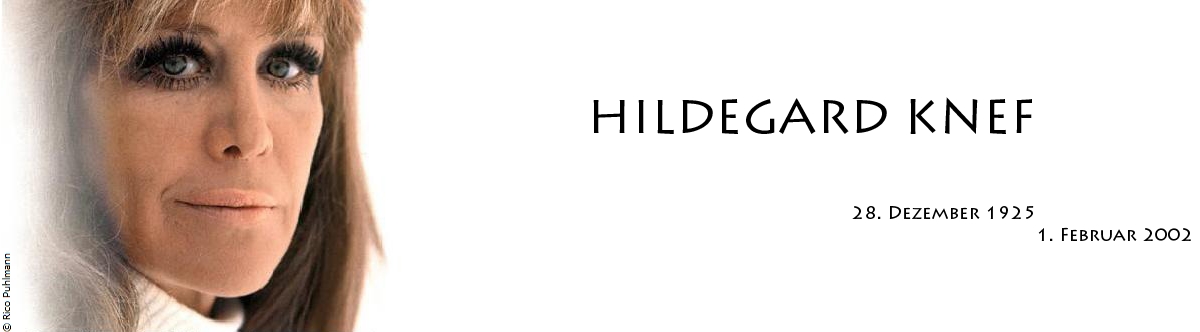
Hildegard Knef: Chronology of her life 1970 – 1979
The author is not responsible for the correctness of the following information.
1970
February 1970:
Release of the LP KNEF – her best album, in her opinion.
March 30, 1970:
German magazine “Jasmin” begins its
advance publication for Der
geschenkte Gaul (titled “Menschenskind”); Hildegard Knef receives DM
370,000 for the preprint rights, although about 150 pages of the books have
not yet been delivered to her publisher.
May 1970:
After finishing her work on the
book, Knef and her family spend 3 months at a friend’s house near St Tropez,
August 4, 1970:
Her first book, Der
geschenkte Gaul – Bericht aus einem Leben, is published in Germany; it
becomes a phenomenal success (reaching the number one spot on the bestseller
list of “Der Spiegel”) and sells approximately 280,000 copies within the
first 6 weeks; Knef receives a basic fee of DM 250,000 plus 17 % of each copy
sold above 100,000; the book will eventually be translated into 17 languages
and becomes an international success, too (in 2002, worldwide sales are
estimated at around 4 million); in the US, the English version (translated by
her husband David Anthony Palastanga),The
Gift Horse, spends a whole year on the bestseller list of the New
York Times, 18 weeks alone at number one; in the UK, the book reaches number
2, just ten days after publication.
September 1970:
Hildegard Knef presents her book at
the Frankfurt book fair; in 6 further presentations throughout Germany she
reaches a total of 3,000 book sellers, each of whom was sent a specimen copy
including a recording with Knef reading excerpts; in autumn and winter, she continues promotion
with book-signings and readings in 26 towns in Germany, Austria and Switzerland
(reaching Berlin on October 20); in 1984, Fritz Molden says in
his book, “Der Konkurs”, Knef did more than 200 of such events, signing about
60,000 copies - resulting in calluses on her hands.
October 20, 1970:
“Bunte” magazine publishes a survey
to determine Germany’s most popular singers; Hildegard Knef is at number 6
with 48 % having a positive opinion about her, 30 % are negative and 22 % are
undecided; Udo Jürgens is the number one star (71 % positive, 15 % negative,
14 % undecided).
November 1970:
Release of the double album Der geschenkte
Gaul – a reading of excerpts by Knef.
|
1971
January 1971:
In a private clinic in
First half of 1971:
Promotes her book throughout Europe
(
June 1971:
Begins a PR tour in the US for The
Gift Horse; appears on the David Frost
Show and twice on the Dick Cavett
Show (34 TV appearances altogether); at a reception in her honour at the
German embassy, ambassador Rolf Pauls says, “What you accomplished in just
one week, we didn’t achieve in 25 years.”
June 27, 1971:
Takes part in
Summer 1971:
Guest of honour at the annual
conference of the American TV academy.
August 21, 1971:
In an interview with the magazine
“Das Neue Blatt” she says, “I am fed up with doing theatre, films and
concerts. (…) I don’t care anymore for this superficial work”.
September 3, 1971:
Concert appearance at the annual
Garden Party by federal president Gustav Heinemann at
October 1971:
Knef’s new album, Worum geht’s hier eigentlich?,
is released immediately after an accompanying TV show, Ich brauch
Tapetenwechsel, got on the air; shortly afterwards her record company,
Decca, ends the DM 2 million contract with her.
Autumn 1971:
The “British Translator’s
Association” awards her husband David Anthony Palastanga with the “Schlegel
Tieck prize” for his English translation of Der
geschenkte Gaul.
December 1971:
Her daughter Christina is being
treated in a
December 29, 1971:
US film magazine “Variety” quotes
Hildegard Knef as saying, “I shall never do another movie unless poverty
forces me to”.
|
1972
April 1972:
In
September 1972:
Hildegard Knef’s third book, Ich
brauch Tapetenwechsel: Texte, is published – containing 70 song lyrics,
poems and short stories written between 1965 and 1972; on October 1st,
“Der Stern” writes a scathing review (“obtrusive perfume” … “platitudinous”).
October 1972:
Her first records on the new
Philips label are released: Texte -
geschrieben und gelesen, with 32 excerpts from her new book,
recited by herself – and the album Und ich dreh’ mich nochmal um.
November 19, 1972:
In an interview with women’s
magazine “Frau im Spiegel”, Knef discloses that for her daughter’s sake she
wants to regain German citizenship: “Because I am connected to
December 1972:
Honouring the BBC’s fiftieth
birthday, a 7” single, Auntie, is released
in several European countries (though not in the
|
1973
April 10, 1973:
The family temporarily relocates to
Jagdschloss Hubertushof, the country house of the Prince of Fürstenberg, in
Strobl beside
April 18, 1973:
Hildegard Knef suffers from a
haemorrhage; her husband rushes her by car to Basle, Switzerland, where she
is operated twice: first, her uterus is removed, then – on May 3rd – parts of her bowel are removed, too, after an acute inflammation of her
abdominal cavity led to an intestinal obstruction; the surgery is impaired by
problems in blood clotting from which she suffers since the delivery of her
child; the doctors considered that second operation as life-threatening; she
gets her first strong doses of morphine; shortly afterwards, she is diagnosed
as having breast cancer.
April 19, 1973:
Knef `73 is aired on
German television, a show featuring many famous contemporaries and companions
giving statements on Knef (Willy Brandt, Henry Miller, Carroll Righter among
others); Knef herself sings 17 songs; musical director: Hans Hammerschmid.
August 6, 1973:
In
Late summer 1973:
The family moves to the “Mühle zum
Feld” near Traunkirchen beside
Autumn 1973:
She delivers her second novel to
publisher Fritz Molden; however, shortly afterwards she destroys the work
(ca. 360 pages); in April, 1975, she tells “Stern” magazine that it was a
non-autobiographical novel about “two very different men with very different
backgrounds”, with one of the characters being a “notorious liar”.
|
1974
February 1974:
Her album Ich bin
den weiten Weg gegangen hits the record stores; its song Ich
gebe alles aufis the only song ever released that Knef has
written and composed herself.
February 1974:
She begins to write Das Urteil whose
first drafts she wrote in the winter of 1973.
Spring 1974:
Shooting for a 90-minute TV show in
Summer 1974:
Hilde Heilmaier, a Bavarian
spiritual healer, claims to have made contact to a Lord Mikaal, said to have
been a dead re-incarnation of the archangel Michael, and she puts Knef on a
“diet on cosmic rays” (fasting for a day, no drinking); she thus manages to
relieve her from post-operative pains.
October 1974:
Convalescent Knef shoots the TV
show Hildegard
Knef und ihre Lieder in Traunkirchen, Gmunden and environs; the show is aired
on April 12, 1975.
|
1975
January 13, 1975:
In
March 23, 1975:
An article in the “Welt am Sonntag”
newspaper reveals that her surgeries in summer were related to cancer –
although the German press had covered Knef’s hospitalisation extensively, the
word “cancer” was never mentioned; in an interview as late as September 1975,
Hildegard Knef herself tells “Bunte” magazine, “As we still don’t know what
kind of condition I have, I cannot call myself healed.”
June 1975:
Publication of her book Das Urteil oder Der
Gegenmensch (working title: “Judgement of God”); the first print has a
circulation of 120,000 copies; in the book, Knef recalls her suffering from
cancer and critically describes the way she has been treated by doctors; this
subject causes a controversy in the German press with many asking if it is
acceptable to talk publicly about cancer; advance excerpts of the book were
published in “Stern” magazine, in a series starting April 30,
1975 (costing “Stern” DM 360,000 – of which Knef received 90 %); illegally
obtained passages were published by competing magazines “Bunte” and “Quick”
before April 30; the book is translated into 15 languages.
June 1975:
A double LP with a reading of
excerpts by Knef is released.
• Promotes the book in several
countries, among them the
August 1975:
The LP Applaus is released – an album
featuring songs from American musicals (translated into German by Gerhard
Bronner).
September 10, 1975:
In Berlin’s Wedding district,
shooting starts for her first movie in 8 years, Jeder stirbt für sich allein,
of which Knef says, “It will probably be my last film”; in the coming months
she lives in suite “Bellevue”, No. 1148/1150 of Kempinski Hotel whose owner,
Rudolf Münster, is a friend of hers; she suffers heavily from morphine detoxification
– the press gets wind of it, resulting in headlines such as “Knef a drug
addict?”, “Evil rumours about her state of mind”.
October 24, 1975:
The German press reports in lurid
detail that Knef threw out her husband from her hotel suite; they quarrelled
about bad contract conditions for the international rights to Das Urteil which
David Cameron had negotiated without consulting Knef; moreover, Cameron
demanded to leave the suite with their common child; as a result, a bodyguard
is posted in front of the door.
|
1976
January 1976:
The book’s English edition, The Verdict, reaches Number 2 on the US bestsellers’
list.
January 21, 1976:
Grand première of Jeder stirbt für sich allein at
February 6, 1976:
In an interview with “Bild”, Knef
discloses that she has moved back to the “Mühle” – together with husband David;
asked whether they have reconciled, she answers, “That doesn’t work just like
that, after the kind of fights we’ve had, does it? In 16 [sic] years of marriage a potential for
tension builds up which has to slowly dissipate first. – Question: No divorce
then? – Knef: Let’s say, the matter’s put on ice.” (The divorce is executed 4
months later).
• At the international film festival
in
• In
June 4, 1976:
After 14 years of marriage the
couple is divorced by a court in
June 1976:
While moving away from the mill
beside Lake Traun, she makes the acquaintance of baron Paul von Schell zu
Bauschlott, an American citizen and Hungarian exile; Schell – 15 years her
junior – had worked as actor in minor parts, as dubbing actor, translator,
and was once an assistant to film director Robert Aldrich; together with him
and her consultant, American Robert Kingsley, Knef moves to a 300 square
meter flat in Berlin-Charlottenburg, Clausewitzstraße 4 (3rd floor); in summer 1977, she and Paul relocate to a 14-room villa in Berlin-Grunewald,
Bettinastraße; during those months, she is in constant fear that her former
husband David might take Christina away from her.
• Knef records a reading of The
Rights of Children, for UNICEF.
August 1976:
The album Bei dir war
es immer so schön is released – an LP with new versions of famous German
standards.
November 1976:
Hildegard Knef meets reknowned
clairvoyant Gabriele Hoffmann for the first time.
December 1976:
Schell proposes to Knef to become
his wife.
|
1977
January 1977:
Just 5 months after her last album,
the LP Lausige Zeiten is released; the record sells poorly.
January 1977:
Guest at the international press
ball in
April 1977:
Fritz Molden, her book publisher,
sells 200,000 hard cover copies of Der
geschenkte Gaul to coffee shop chain “Eduscho” (a deal worth 1 million
D-marks); the books are sold at a price of just DM 7,95.
June 1, 1977:
Marriage to Paul von Schell in
Berlin-Charlottenburg; Carroll Righter is one of the witnesses; 8 days
before, her ex-husband David also married (Austrian countess Dorothea “Pumpi”
Lamberg).
June 1977:
The newly-weds Hildegard and Paul
have to spend their honeymoon on the Greek island of Lefkas where Knef shoots
Billy Wilder’s last film, Fedora;
more shooting work follows at Bavaria studios in Munich, and in Paris; a
special make-up injures her eye, requiring surgery.
Summer/Autumn 1977:
Works on her new book, Nichts als
Neugier.
August 1977:
Receives the Bundesfilmpreis
(Federal Film Prize) for life achievement.
Autumn 1977:
Guest of honour in the TV show Musik ist Trumpf.
October 20, 1977:
A public fight erupts between Knef
and her former husband on the upcoming surgery on their daughter Christina;
in an interview with “Das Neue Blatt”, Cameron – who rejects the operation’s
necessity – criticises Knef harshly: “I deeply despise Hilde for what she’s
doing to our child. This way, Tinta will eventually go to the dogs. (…) Only
hell can be worse than an abandoned wife”; for her part, Hildegard Knef
deplores Cameron’s statements in interviews.
October 1977:
In
October 27, 1977:
Advance excerpts of Nichts als
Neugier are printed in “Bunte” magazine, titled “Beyond Tomorrow”.
December 8, 1977:
Knef and Schell are interviewed by
gossip magazine “Das Neue Blatt”; they report that Christina has to be
protected by bodyguards day and night; her operation had cost them DM 50,000
altogether; the move to Bettinastraße took another DM 50,000; regarding their
running costs, Knef says, “4,000 marks for rent each month, heating charges,
expenses for employees, agents and taxes – there’s not much left on our bank
account”; Schell adds, “We need money. That is the reason why we didn’t buy
our house in
• Hildegard Knef falls out with
long-time secretary Ingrid Goll and fires her.
|
1978
January 1978:
Her new album Heimweh-Blues is
released, a commerical flop; in August, a book is
published under that name featuring texts by Knef (and others) describing
paintings by Hans Kossatz.
March 22, 1978:
At
May 1978:
Her book Nichts als
Neugier is published by German publishing house Goldmann; in it, she
interrogates several celebrities on the subject of parapsychology: Leni
Riefenstahl, Lilli Palmer, Bruno Kreisky, Françoise Sagan, Niki Lauda, Henry
Miller (among others).
May 29, 1978:
Knef is present at the première of Fedora at the
July 14, 1978:
Guest at federal president Walter
Scheel’s state banquet for
August 29, 1978:
Her half-brother Heinz Wulfestieg
dies in
October 7, 1978:
Celebrating the 75 birthday of actor colleague Hans Söhnker, she writes the article Unsere
Zusammenarbeit war Lachen for TV magazine “Gong”.
October 1978:
Her second album of the year is
released, Überall
blühen Rosen, on which she sings French chansons in German translation;
the LP is a flop.
|
1979
March 19, 1979:
Knef is hospitalised for gall
surgery at
June 1979:
Christina’s godmother Vera Kálmán –
widow of operetta composer Emmerich Kálmán – announces that after her death
she will bestow Christina with a large share of her fortune.
• In Berlin, shooting takes place for
the documentary Hildegard
Knef’s Berlin from the series “Cities” in which celebrities portray
cities close to their heart (e.g. Peter Ustinov – Leningrad, Glenn Gould –
Toronto, Melina Mercouri – Athens); it is a project by the Learning Corporation
of America intended for US high schools; in 1981, an accompanying book is published.
August 1979:
Release of Eins & Eins, an
LP produced in collaboration with Bert Kaempfert and his orchestra.
Autumn 1979:
Tumultous reception for Knef, the
guest of honour at the “Berliner Tuntenball” (“pansys ball”); it is
her first concert appearance in 10 years; she is accompanied for the first
time by pianist and composer Kai Rautenberg; the concert is managed by her
new friend and assistant Axel Andree (in later years, author of 2 books on
her).
Autumn 1979:
In
December 11, 1979:
In a 5-hour operation in
December 28, 1979:
Guest appearance on the successful
TV detective series Der
Alte.
|